
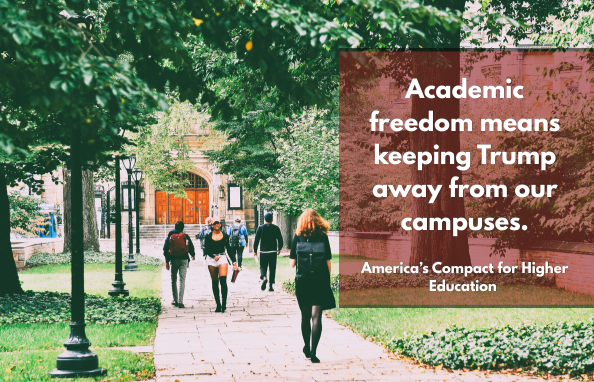
America’s Compact for Higher Education is our united response to the Trump administration’s effort to bend the will of America’s higher ed leadership to his authoritarian control.
Please read and share America’s Compact for Higher Education with your institution’s leadership using our select and email tool below, insisting that they join us in this Compact of historical resistance.
AMERICA’S COMPACT FOR HIGHER EDUCATION
Since before the founding of our country, America’s universities and colleges have served their students, communities, and society. They have created rigorous learning environments, for both students and faculty, to tackle some of the most challenging questions and vexing problems humanity faces, and in so doing push on the frontiers of human knowledge. Our higher education system is one of the core pillars for democracy in America and one of the most well-traveled pathways to achieving the American Dream.
As higher education expanded in the 19th century, so, too, did the idea of an informed citizenry. It blended the academic traditions of people traveling to the country, first by seeking to increase people’s civic knowledge. The Morrill Acts created America’s system of land grant institutions, which were explicitly chartered to provide for a practical education in science, technology, and agricultural training, thus expanding educational opportunities beyond elites. The Fourteenth Amendment’s incorporation of the Bill of Rights at the state level promoted academic freedom, particularly within public institutions, and provided safeguards against unreasonable government intrusion.
Over time, education at all levels became recognized as a key thoroughfare to the attainment of life, liberty, and the pursuit of happiness for all people. The value of an American education stems from its ability to provide not only educational opportunities, but also access to independent centers of thought necessary to promote the free exchange of ideas in a protected space devoted to the pursuit of knowledge, truth, and wisdom. The combination of education, opportunity, and access has elevated hundreds of millions of people, creating lasting impacts on community and culture. According to the latest Bureau of Labor Statistics data, 65.2 million employed adults age 25 and over have a bachelor’s degree or higher. Another 16.1 million hold an associate’s degree as their highest credential. Together, associate’s and bachelor’s-or-higher credentials account for more than 81 million working adults and reflect the outsized role higher education plays in preparing the U.S. workforce.
Eleven Affirmations
Upon this basis, we sign to affirm the following:
With academic freedom comes the ability to answer our most vexing and uncomfortable questions. Although this can be challenging and inconvenient to various parties, academic freedom is essential to the discovery and development of knowledge.
Knowledge has inherent value, and it is through the dissemination of that knowledge and its interaction with human experience that goods may be valued. These goods are not merely monetary, but also social, political, civic, and cultural.
Knowledge is not inherently neutral, and can contain truths that may feel threatening to different parties at different times. It is important for society and government to facilitate the development of knowledge–allowing for challenges within academic settings through disciplinary expertise and peer review–rather than suppressing it, so that the consequences of that knowledge and its exploration may be better understood.
Maintaining higher education institutions as independent centers of thought requires protecting them from political forces that might form in opposition to the creation of knowledge. In general, the principle of institutional self-governance must be preserved.
The experiences gained at educational institutions are not limited to workforce preparation, leadership development, and skills training, but also comprise one’s interactions with others, including with individuals from beyond our borders, which expands our perspective and broadens the possibilities of potential knowledge.
These experiences extend outside the immediate surroundings of the university or college to include their local communities and visitors traveling to, and in proximity to, campuses. It is no accident that America’s economic hubs for innovation and talent cluster around higher education institutions.
Effectively facilitating the interaction of knowledge and human experiences requires providing as many people as possible the opportunity to participate in the formation and documentation of knowledge, regardless of their social, economic, or racial background. It is therefore the responsibility of institutions to do the utmost to provide educational access to all who seek it and to ensure that all students have fair opportunities to learn and thrive in the safest and most supportive environment possible.
With the creation of public goods, including new knowledge, comes significant responsibility to ensure that these goods are deployed in ways that are consistent with the general welfare, including protection from harm and from violations of fundamental rights.
When the rights of those in institutions of higher education are violated, when knowledge is suppressed, then the goods created by the institutions are also suppressed. This extends broader harm to the rest of society.
From the creation of new knowledge we gain additional tools to navigate human experience, and through the rigorous, responsible, and informed use of those tools, the rest of society benefits.
Since societies benefit from the products of knowledge derived in institutions of higher learning and independent thought, there is inherent value in public investment in these experiences.
The growing list of public endorsers of America’s Compact for Higher Education include the following organizations and their leadership:
American Association of Colleges & Universities
The American Association of University Professors
The Alliance for Higher Education
American Federation of Teachers
Democracy Forward
Public Citizen
Carolyn Bertozzi, Nobel Laureate
Victor Ambros, Nobel Laureate
Jack Szostak, Nobel Laureate
Ardem Patapoutian Nobel Laureate
Randy Schekman, Nobel Laureate
To add your organization to this list, please contact [email protected].